Industrial piping systems handling chemicals, treatment fluids, and process liquids require careful material selection to avoid corrosion-related maintenance problems. PVDF Valves and Fittings for Corrosion-Resistant Industrial Piping in Meghalaya offer an option for suitable chemical-handling applications. Parthiv Polymers provides manufacturing support from Ahmedabad, Gujarat, India.
1. Why PVDF Material Matters in Industrial Fluid Transfer
PVDF (Polyvinylidene Fluoride) is a high-performance thermoplastic used in industrial piping applications where chemical resistance, mechanical strength, and temperature stability are important.
Unlike conventional metallic components, PVDF does not experience electrochemical rusting. However, its compatibility still depends on the chemical being transported and the operating environment.
Industrial facilities may consider PVDF components for:
- Chemical transfer lines: Moving compatible acids, chemical solutions, and process liquids.
- Pharmaceutical operations: Supporting suitable fluid-handling arrangements where material compatibility matters.
- Water treatment plants: Connecting chemical dosing and treatment sections.
- Textile processing: Handling selected dyes, chemicals, and treatment solutions.
- Pollution control systems: Supporting compatible chemical circulation and treatment processes.
For industrial projects in Meghalaya, selecting the correct piping material can help address corrosion concerns and reduce the need for frequent component replacement.
2. How Valves and Fittings Coordinate Within a Piping Network
A piping network requires different components to perform specific functions. Valves control fluid movement, while fittings connect pipeline sections and establish the required flow direction.
The main components include:
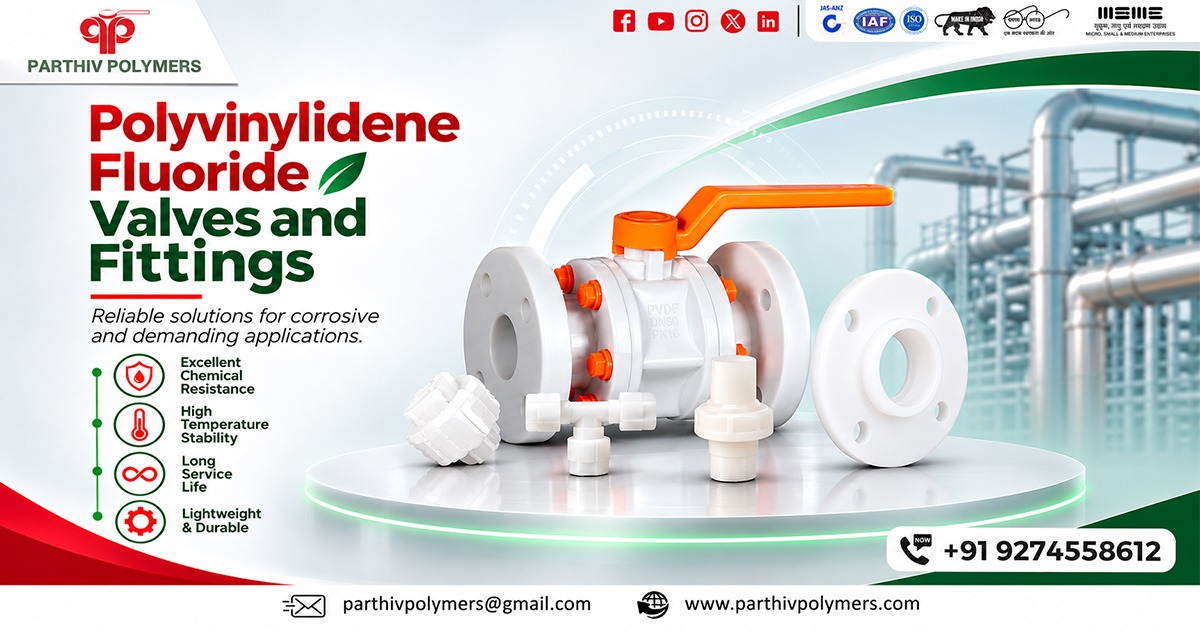
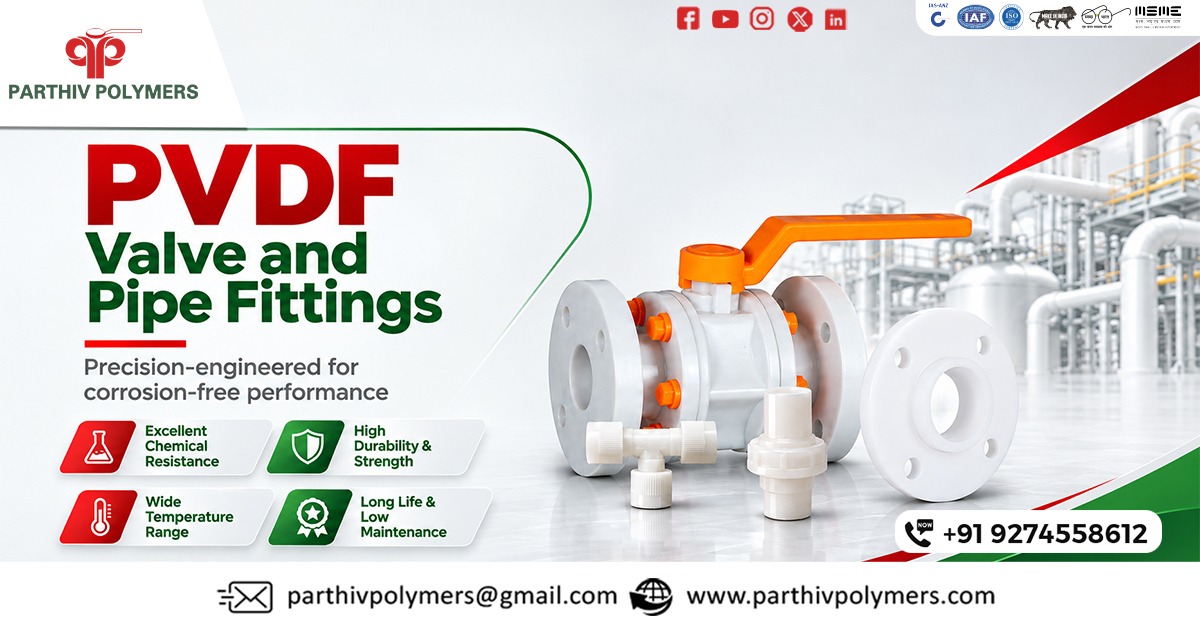
- PVDF Ball Valves: Used to open or isolate fluid flow through a pipeline.
- PVDF Elbows: Change the direction of pipeline routing, commonly through 45-degree or 90-degree connections.
- PVDF Tees: Create branch connections for distributing fluids between different process sections.
- PVDF Reducers: Connect pipes with different diameters.
- PVDF Flanges: Provide connection points for assembling or dismantling compatible pipeline sections.
- PVDF Couplings: Join straight pipeline sections.
These components work together to create an organised fluid-handling arrangement.
An important planning consideration is that valve selection and fitting dimensions should be coordinated with the pipe material, connection method, and available installation space. A chemically compatible valve can still become a weak point if its gasket, joining arrangement, or adjoining components are unsuitable.
3. Industrial Conditions That Influence PVDF Component Selection
The material selection process should begin with the actual operating conditions rather than the product name alone.
Several factors can influence whether PVDF is appropriate for a particular industrial application.
Chemical concentration: The resistance of PVDF can vary according to the chemical’s concentration and composition. Buyers should verify compatibility for the exact fluid.
Operating temperature: Temperature affects material behaviour and pressure-handling capability. Maximum operating conditions should be checked before finalising the product.
Working pressure: Normal operating pressure, pressure fluctuations, and possible surges must be considered when selecting valves and fittings.
Fluid purity: Pharmaceutical and other sensitive applications may require additional attention to contamination control, material grade, and surface condition.
Connection requirements: Threaded, flanged, or fusion-based arrangements must match the piping system design.
For example, a hypothetical chemical processing facility in Meghalaya may have separate pipelines for transferring raw chemicals and circulating treatment solutions. Both lines might require corrosion-resistant components, but their chemical concentrations, operating temperatures, and connection arrangements could differ. Therefore, using one standard component specification for both lines may not be appropriate.
4. Planning a Compatible Pipeline Before Procurement
One common purchasing mistake is ordering valves and fittings based only on nominal pipe diameter. A complete pipeline arrangement requires several interconnected technical details to be checked.
Before purchasing PVDF Valves and Fittings for Corrosion-Resistant Industrial Piping In Meghalaya, industrial buyers should evaluate the following:
1. Chemical compatibility: Share the exact chemical name, concentration, and any cleaning chemicals used in the system. This helps determine whether PVDF is suitable.
2. Pressure and temperature: Provide normal and maximum operating conditions so the supplier can help verify the appropriate product rating.
3. Pipe dimensions: Confirm nominal diameter, actual dimensions, wall thickness, and connection requirements to avoid mismatched components.
4. Valve operation: Identify whether the process requires isolation, flow control, non-return functionality, or another valve arrangement.
5. Installation layout: Check available space, pipeline routing, support arrangements, and maintenance access before ordering.
6. Documentation: Request relevant product specifications, material information, pressure ratings, and connection details for engineering approval.
These checks are particularly important when adding new components to an existing pipeline because even small dimensional differences can affect installation and sealing.
5. Installation and Maintenance Factors That Should Not Be Overlooked
Correct product selection is only one part of reliable pipeline operation. Installation practices also influence the performance of the complete assembly.
Industrial project teams should pay attention to:
- Follow the joining procedure specified for the selected PVDF piping system.
- Avoid excessive mechanical stress on valves and fittings during installation.
- Use compatible gaskets and sealing materials.
- Provide suitable pipeline supports to manage mechanical loads.
- Check alignment before tightening flanged connections.
- Conduct an appropriate pressure or leak test before introducing process chemicals.
- Inspect joints, seals, and valve operation during planned maintenance.
PVDF components should not be assumed suitable for every industrial chemical or every temperature-pressure combination. Periodic inspection and application-specific maintenance procedures remain important.
6. Parthiv Polymers: Manufacturing Support for Industrial Piping Requirements
Parthiv Polymers manufactures and supplies industrial plastic valves, pipes, and fittings under the Parthiv brand. Its product range includes PP, HDPE, PVDF, PPRC, and PPH material categories. The company lists PVDF ball valves with flange-end connections among its plastic valve offerings.
With manufacturing support from Ahmedabad, Gujarat, India, the company caters to industrial piping requirements across different sectors.
Buyers planning PVDF Valves and Fittings for Corrosion-Resistant Industrial Piping In Meghalaya can discuss their application requirements with the company before finalising a purchase.
Relevant product and support areas include:
- Plastic Valve Supply: Product options for suitable industrial fluid isolation and flow management.
- Piping Component Selection: Assistance in identifying relevant valve and fitting categories.
- Industrial Product Coordination: Discussion of pipe dimensions, connection arrangements, and application requirements.
- Product-Related Assistance: Support with product enquiries, specifications, and procurement-related questions.
The exact PVDF fitting types, dimensions, and connection configurations should be confirmed with Parthiv Polymers according to the project requirement.
Website: https://parthivpolymers.com/
7. Industrial Piping Requirements Across Meghalaya
Meghalaya has industrial and commercial activity connected with cement manufacturing, mineral processing, infrastructure, water management, and other sectors. These operations may require suitable fluid-handling components depending on their individual processes.
For businesses evaluating corrosion-resistant piping materials, Parthiv Polymers provides manufacturing support from Ahmedabad, Gujarat, India.
Relevant cities, towns, and industrial locations include:
Shillong, Tura, Jowai, Nongpoh, Williamnagar, Baghmara, Nongstoin, Mairang, Khliehriat, Sohra, Dawki, Mawlai, Umsning, Byrnihat, Umiam, Umroi, Mawryngkneng, Pynursla, Cherrapunji, Resubelpara, Mendipathar, Ranikor, Mawkyrwat, and Ampati.
These locations represent potential industrial, infrastructure, and commercial sourcing markets rather than confirmed company branches or service centres. Buyers can discuss their project requirements and product availability directly with the Ahmedabad-based manufacturer.
8. Frequently Asked Questions About PVDF Industrial Piping
Q1. Why are PVDF valves considered for chemical-handling applications?
PVDF offers resistance to many chemicals, along with mechanical strength and thermal stability. Its suitability must be checked against the actual chemical concentration, temperature, and operating pressure.
Q2. Which PVDF fittings are used in industrial piping systems?
Common fitting categories include elbows, tees, reducers, couplings, flanges, and end caps. The required type depends on pipeline routing, connection dimensions, and system design.
Q3. What information should buyers provide when requesting PVDF valves and fittings?
Buyers should share the chemical name, concentration, operating temperature, pressure, pipe diameter, valve type, connection arrangement, and required quantities.
Q4. Can PVDF components be connected to an existing industrial pipeline?
Yes, subject to dimensional, material, pressure, and connection compatibility. Buyers should verify joining methods, gasket suitability, and the requirements of the existing piping system before installation.
Conclusion
Selecting suitable piping components requires more than identifying a corrosion-resistant material. Chemical compatibility, operating pressure, temperature, connection dimensions, and installation conditions must all be evaluated. Parthiv Polymers offers manufacturing support from Ahmedabad, Gujarat, India, for industrial plastic piping requirements. Contact the company to discuss your PVDF valve and fitting requirements for projects in Meghalaya.
Website: www.parthivpolymers.com
Phone No:+91 9274558612
Email Id: parthivpolymers@gmail.com