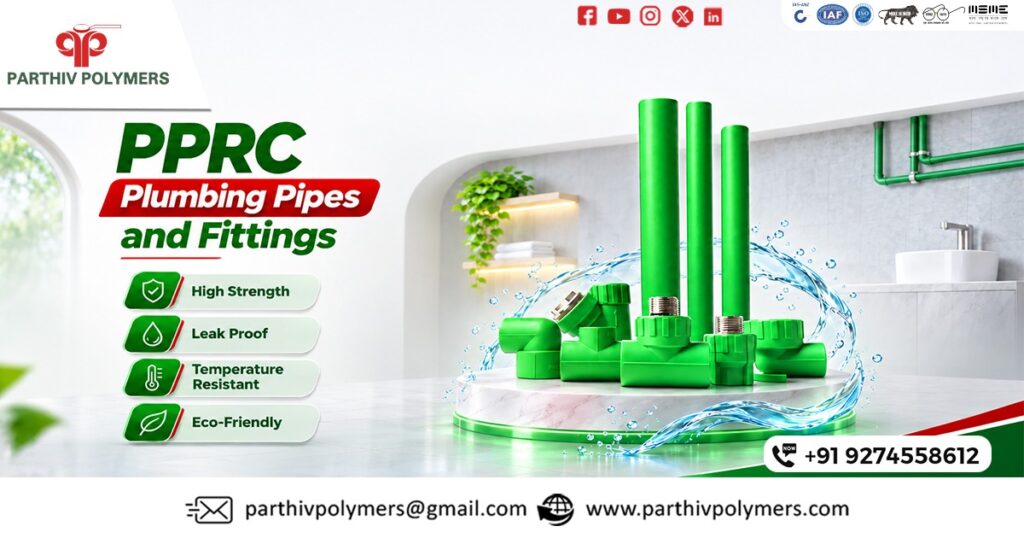
PPRC plumbing systems require suitable pipe dimensions, compatible fittings and reliable jointing to prevent leakage and installation issues. Parthiv Polymers supports buyers seeking PPRC Plumbing Pipes and Fittings Supplier In Kerala, with manufacturing support from Ahmedabad, Gujarat, India.
Why PPRC Pipe Systems Need Proper Component Matching
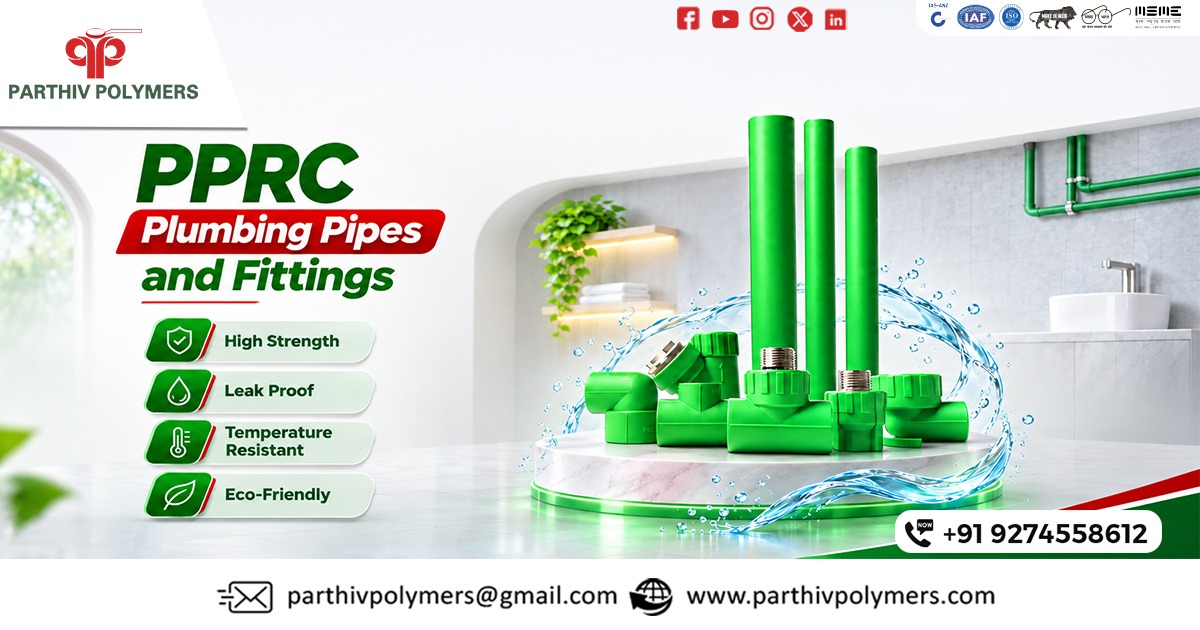
PPRC stands for Polypropylene Random Copolymer, a thermoplastic material used in piping systems for hot-water and cold-water distribution. Pipes and fittings work together to create a connected network for transporting water and other suitable fluids.
A plumbing installation is not made reliable by selecting pipes alone. Every bend, tee, reducer, coupling and threaded connection must suit the pipeline layout.
Parthiv Polymers lists PPRC pipes in the following configurations:
- Material: Polypropylene Random Copolymer (PPRC)
- Available sizes: 20 mm to 315 mm
- Pressure classes: PN10, PN16 and PN20
- Available colours: Green, white, grey and other customised colour options
- Pipe lengths: 3 metres and 5 metres
- Joining method: Socket fusion
The company’s product information also lists IS 15801 and DIN 8077. Buyers should confirm the applicable standard and documentation for their specific project before ordering.
Parthiv
Selecting the Correct Pressure Class for Kerala Projects
Pressure rating is one of the first technical considerations when purchasing plumbing pipes. Selecting a pipe only by its outside diameter can result in an unsuitable installation.
The appropriate pressure class depends on the operating pressure, water temperature, system design and expected service conditions.
Consider these points:
- PN10: Evaluate for applications with comparatively lower pressure requirements.
- PN16: Consider where the system design calls for a higher pressure classification.
- PN20: Evaluate for applications requiring a higher nominal pressure rating.
These are nominal pressure classifications, not a substitute for checking the actual operating conditions.
For Kerala projects involving residential buildings, hotels, hospitals, commercial complexes and industrial facilities, buyers should discuss the intended application before finalising the pipe class.
Also verify:
- Required pipe diameter and wall thickness.
- Maximum operating temperature.
- Water supply pressure.
- Expected flow rate.
- Compatibility with connected equipment.
- Applicable project specifications.
Fittings That Make Complex Plumbing Layouts Easier
A pipeline often needs to change direction, divide into branches or connect to equipment with different connection sizes. This is where compatible fittings become essential.
Parthiv Polymers lists several PPRC fitting configurations for different piping arrangements.
Parthiv
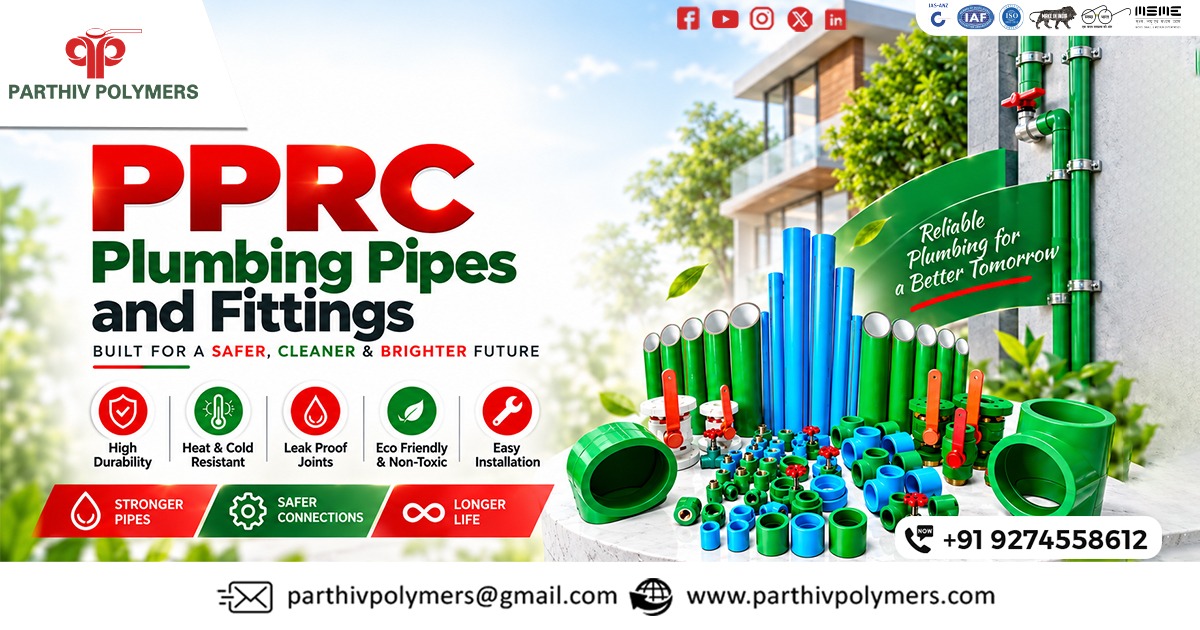
Common fitting options include:
- 90-degree and 45-degree bends: For changing pipeline direction.
- Equal tees and reducing tees: For creating branch connections.
- Couplers: For joining compatible pipe sections.
- Reducers: For connecting different pipe diameters.
- End cups: For closing pipeline ends.
- Unions: For suitable detachable connections.
- Core and slip-on flanges: For flange-based pipeline connections.
- Brass threaded fittings: For connecting compatible threaded equipment and accessories.
The listed manufacturing ranges vary by fitting type. For example, standard bends and tees are listed from 20 mm to 160 mm, while certain buttweld fittings are listed from 200 mm to 315 mm.
Buyers should prepare a fitting schedule before procurement rather than ordering pipes first and identifying missing components during installation.
How Socket Fusion Creates a Connected Pipeline
Socket fusion is the joining method specified for the company’s PPRC pipes. It uses controlled heating to prepare the pipe and fitting surfaces for joining.
A typical installation sequence involves:
- Measurement: Measure the required pipe length and mark the insertion depth.
- Preparation: Cut the pipe squarely and ensure the joining surfaces are clean.
- Heating: Use compatible socket-fusion equipment and dies according to the manufacturer’s instructions.
- Joining: Insert the heated pipe and fitting together to the specified depth without twisting.
- Cooling: Allow the joint to cool undisturbed for the recommended period.
- Inspection: Check alignment, joint appearance and connection quality before proceeding with testing.
Correct heating temperature, heating time, insertion depth and cooling time depend on pipe dimensions and the equipment manufacturer’s instructions.
Poorly prepared joints, excessive heating or incorrect alignment can affect the connection. Installation should therefore be performed by trained personnel using suitable fusion equipment.
Installation Planning for Buildings and Plumbing Networks
Kerala projects can involve different site conditions, from residential construction to large commercial buildings and industrial facilities. Planning the pipeline route before installation helps reduce unnecessary joints and fitting requirements.
Important installation considerations include:
- Pipeline routing: Plan routes around walls, ceilings, equipment and service areas.
- Pipe support: Provide suitable supports according to pipe dimensions and installation conditions.
- Thermal movement: Account for expansion and contraction, particularly in hot-water pipelines.
- Equipment connections: Check compatibility with pumps, heaters, tanks and other connected systems.
- Access points: Keep valves and detachable connections accessible for future inspection.
- Pressure testing: Test the completed system according to the project specification and applicable installation instructions.
Avoid concealing pipelines before the required inspection and testing stages are completed.
Identifying Joint and Flow Problems Before They Become Costly
Even a suitable piping material can experience problems when installation, component selection or operating conditions are incorrect.
The following table highlights common issues and general inspection points.
| Common issue | Possible cause | Practical check |
| Leakage at joints | Improper fusion or incompatible components | Inspect the joint and installation records |
| Reduced water flow | Undersized pipe or blockage | Check pipe sizing and system layout |
| Misaligned pipeline | Incorrect positioning during joining | Inspect alignment and support arrangement |
| Damaged threaded connection | Excessive tightening or incompatible threads | Verify thread type and connection condition |
| Pipe deformation | Unsuitable temperature or support conditions | Review operating conditions and installation design |
| Repeated joint problems | Inconsistent fusion procedure | Review installer practices and equipment instructions |
Any corrective work should follow the manufacturer’s recommendations. Pressure testing and inspection should be carried out using suitable procedures rather than attempting repairs on a live pressurised line.
Services
For plumbing procurement and project coordination, the following service requirements are relevant:
- PPRC pipe and fitting selection based on project specifications.
- Guidance on pipe dimensions, pressure classes and compatible connections.
- Product coordination for residential, commercial and industrial piping requirements.
- Technical assistance regarding product selection and installation-related queries.
Location
Kerala has diverse construction, infrastructure and industrial requirements where suitable PPRC plumbing components may be needed for water distribution and building services. Buyers can explore procurement requirements across Thiruvananthapuram, Kochi, Kozhikode, Thrissur, Kollam, Kannur, Alappuzha, Palakkad, Kottayam, Malappuram, Kasaragod, Pathanamthitta, Idukki, Wayanad, Ernakulam, Thalassery, Manjeri, Perinthalmanna, Tirur, Ponnani, Muvattupuzha, Angamaly, Kalamassery, Kanjikode and Eloor.
Product Selection and Manufacturing Support From Parthiv Polymers
Parthiv Polymers provides plastic piping products, including PPRC pipes and fittings, for plumbing and other fluid-handling requirements.
With manufacturing support from Ahmedabad, Gujarat, India, the company offers pipe sizes from 20 mm to 315 mm and different fitting configurations to suit varying pipeline arrangements.
Its product range includes bends, tees, reducers, couplers, unions, flanges and brass threaded fittings.
Buyers and distributors can visit https://parthivpolymers.com/ to explore the product range and discuss their requirements.
For Kerala procurement, sharing the pipe sizes, pressure class, fitting quantities, application and project specifications can help make product discussions more precise.
Frequently Asked Questions
Q: Which PPRC pipe sizes are available for plumbing projects?
A: Parthiv Polymers lists PPRC pipes from 20 mm to 315 mm. The required diameter depends on flow demand, pipeline design and operating conditions.
Q: How should buyers select between PN10, PN16 and PN20 pipes?
A: Selection depends on operating pressure, temperature and project requirements. Buyers should verify the design conditions before choosing a pressure class.
Q: Can PPRC pipes connect with metal plumbing components?
A: Yes, suitable threaded brass fittings and compatible transition connections can be used. The connection type, thread dimensions and operating conditions should be checked before installation.
Q: What should Kerala distributors check before placing a bulk order?
A: Confirm pipe sizes, pressure classes, fitting combinations, quantities, packaging, product documentation and delivery requirements. A detailed material list helps avoid missing components.
Conclusion
Reliable plumbing installations depend on compatible pipe dimensions, suitable pressure ratings and correctly installed fittings. Buyers searching for PPRC Plumbing Pipes and Fittings Supplier In Kerala should evaluate project conditions before procurement. Parthiv Polymers offers product options with manufacturing support from Ahmedabad, Gujarat, India.
Contact Parthiv Polymers to discuss your PPRC pipe and fitting requirements, obtain product selection guidance and plan procurement for your Kerala plumbing project.
Website: www.parthivpolymers.com
Phone No:+91 9274558612
Email Id: parthivpolymers@gmail.com
View Product: Click Here