Chemical transfer lines require materials that can handle demanding process conditions without frequent corrosion-related replacements. Polyvinylidene Fluoride Valves and Fittings for Chemical Industries support controlled fluid handling, with Parthiv Polymers offering manufacturing support from Ahmedabad, Gujarat, India.
Why Chemical Transfer Lines Require Careful Material Selection
Chemical processing plants handle acids, alkalis, solvents, and other process fluids that can affect conventional piping materials.
Selecting an unsuitable valve or fitting can create problems such as:
- Chemical corrosion: Incompatible materials may deteriorate after prolonged fluid contact.
- Leakage at joints: Poor connection selection or incorrect installation can affect pipeline integrity.
- Unplanned maintenance: Damaged components can interrupt chemical transfer operations.
- Material contamination: Certain processes require piping materials that minimise unwanted interaction with the conveyed fluid.
- Operating temperature changes: Temperature variations can influence material performance and pressure-handling capacity.
PVDF (Polyvinylidene Fluoride) is a fluoropolymer used in industrial piping because of its chemical resistance, mechanical strength, and thermal stability. However, suitability must always be checked against the actual chemical, concentration, temperature, and operating pressure.
How PVDF Valves and Fittings Work Together in a Chemical Pipeline
A chemical piping system requires more than a suitable pipe material. Valves regulate the flow, while fittings connect different pipeline sections and help create the required layout.
The main functions include:
- Flow regulation: Ball valves control the movement of liquid through the pipeline by opening or closing the flow passage.
- Pipeline connection: Fittings join straight pipe sections and help accommodate changes in direction or diameter.
- Branch distribution: Suitable tee connections divide the flow towards different processing sections.
- Maintenance access: Appropriate unions and flanged connections can make selected pipeline sections easier to disconnect.
- Flow isolation: Valves allow operators to isolate specific sections during planned maintenance or process changes.
Common components to consider:
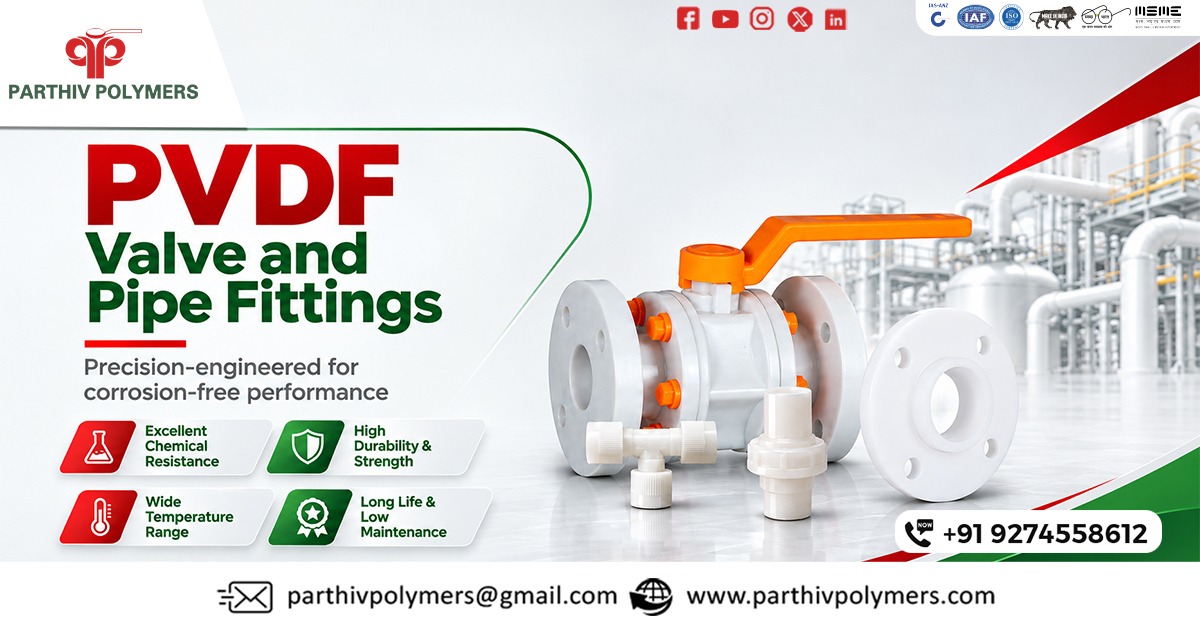
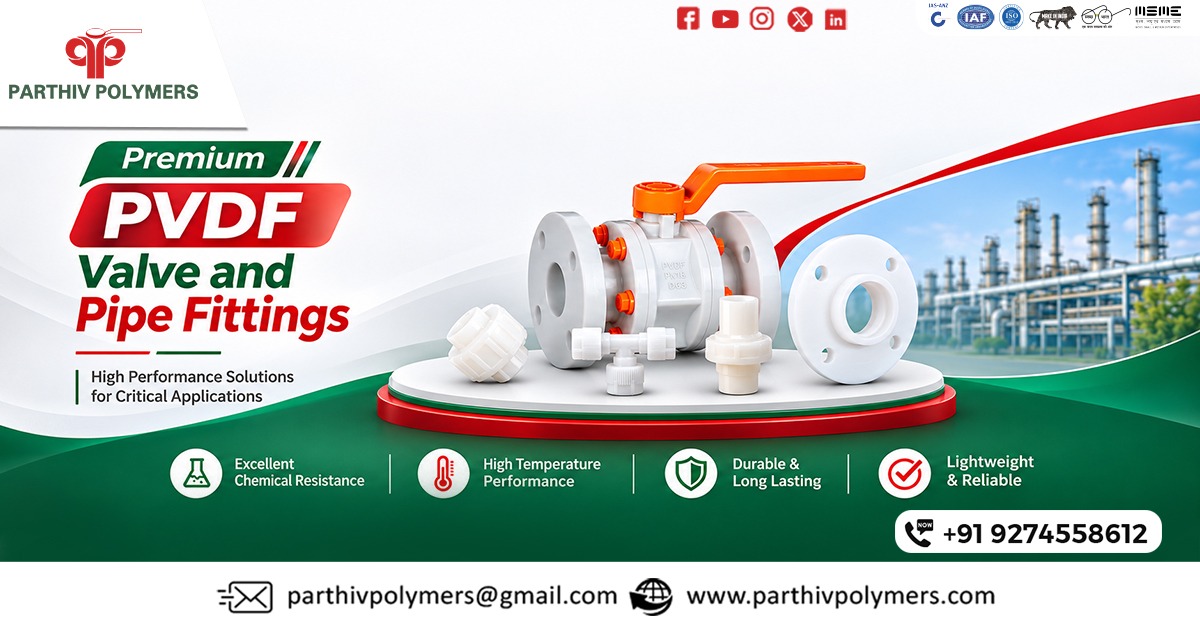
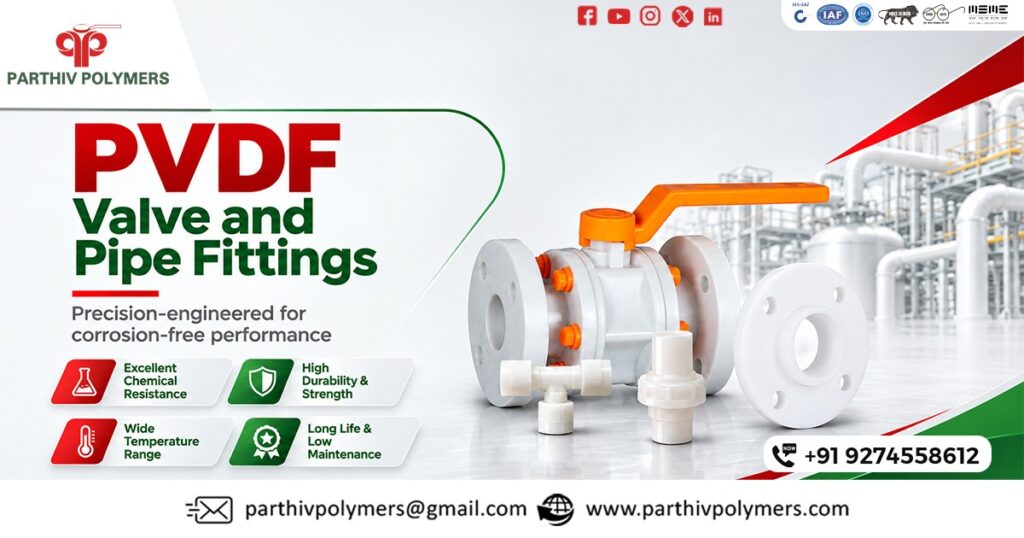
- PVDF ball valves
- PVDF elbows
- PVDF equal and reducing tees
- PVDF reducers
- PVDF couplings
- PVDF flanges
- PVDF end caps
The availability, dimensions, and connection options should be confirmed against the supplier’s current product range.
Where These Components Fit Into Chemical Manufacturing Operations
Different production processes require different fluid-handling arrangements. PVDF components may be considered where chemical compatibility and operating conditions support their use.
| Industrial operation | Piping requirement |
| Acid handling | Transfer lines for compatible acidic solutions |
| Chemical processing | Controlled movement of process chemicals |
| Pharmaceutical production | Chemical transfer in suitable process systems |
| Water treatment | Handling compatible treatment chemicals |
| Textile processing | Transfer of selected dyes and chemical solutions |
| Pollution control | Chemical dosing and treatment pipelines |
| Semiconductor processing | Applications requiring suitable high-purity material systems |
The actual suitability depends on the chemical composition, purity requirements, operating environment, and applicable process specifications. PVDF should not automatically be considered compatible with every chemical.
Five Technical Details to Confirm Before Placing an Order
The correct product selection starts with operating information rather than pipe diameter alone.
1. Chemical composition
- Identify the exact chemical name.
- Confirm its concentration and purity.
- Check compatibility with PVDF at the intended operating temperature.
- Consider mixtures, cleaning agents, and occasional process chemicals.
2. Operating pressure
- Identify normal working pressure.
- Consider maximum pressure during operation.
- Account for pressure fluctuations and possible surges.
- Verify the pressure rating of the complete assembly.
3. Temperature conditions
- Record normal operating temperature.
- Identify minimum and maximum temperatures.
- Check how temperature affects the pressure rating.
- Consider thermal expansion in the pipeline layout.
4. Connection arrangement
- Determine whether threaded or flanged connections are required.
- Confirm the pipe dimensions and fitting compatibility.
- Check flange drilling and gasket requirements.
- Ensure the connection method suits the installation environment.
5. Valve configuration
- Select the appropriate valve type for the process.
- Confirm the required flow direction and operating arrangement.
- Check whether manual or automated operation is needed.
- Consider accessibility for inspection and maintenance.
A properly matched component should be evaluated as part of the complete piping assembly, not as an isolated purchase.
Installation Practices That Help Prevent Pipeline Problems
Even chemically compatible materials can experience leakage or mechanical damage when installation is poorly planned.
Follow these general installation considerations:
- Pipeline alignment: Keep connected components properly aligned to avoid unnecessary mechanical stress.
- Support arrangement: Provide adequate pipe supports so valves and fittings do not carry excessive pipeline loads.
- Joint preparation: Follow the recommended joining procedure for the selected connection type.
- Gasket selection: Ensure gasket materials are suitable for the chemical and temperature conditions.
- Thermal movement: Allow for expansion and contraction where required.
- Accessibility: Keep operating handles, joints, and inspection points accessible.
- Initial testing: Conduct appropriate pressure and leakage testing according to the system design and applicable procedures.
Installation should be performed by qualified personnel following the product manufacturer’s instructions. Never exceed the rated pressure or temperature of the components.
Maintenance Checks for Consistent Chemical Flow
PVDF components offer corrosion resistance, but the complete piping system still requires regular inspection.
Recommended inspection points:
- Examine valve bodies for visible damage or deformation.
- Check joints and flange connections for leakage.
- Inspect seals and gaskets for deterioration.
- Observe whether valves operate smoothly.
- Look for unusual vibration or movement around pipeline supports.
- Check for deposits or blockages where process fluids may leave residue.
- Replace damaged components with compatible replacement parts.
Common operating issues and practical checks
| Common Issue | Possible Cause | Practical Check |
| Leakage near joints | Incorrect assembly or damaged gasket | Inspect joint alignment and gasket suitability |
| Difficult valve operation | Deposits or internal wear | Check operating condition as per manufacturer instructions |
| Reduced fluid flow | Blockage or incorrect valve position | Inspect the flow path and valve position |
| Pipeline movement | Inadequate pipe support | Review support arrangement |
| Repeated seal leakage | Chemical incompatibility or incorrect installation | Verify seal material and assembly procedure |
Maintenance frequency should depend on process conditions, operating hours, chemical exposure, and supplier recommendations.
Quality Checks Procurement Teams Should Include
Before accepting an order, procurement teams should verify whether the supplied components match the engineering requirement.
Purchase verification checklist:
- Confirm that the material is specified as PVDF.
- Verify product dimensions and nominal pipe size.
- Check pressure and temperature ratings.
- Confirm chemical compatibility.
- Verify flange, threaded, or other connection requirements.
- Check valve configuration and intended application.
- Review available material and product documentation.
- Confirm inspection and testing requirements.
- Discuss replacement parts and maintenance support.
- Clarify delivery quantities and project timelines.
Common purchasing mistakes to avoid:
- Selecting components based only on price.
- Assuming all acids and solvents are compatible with PVDF.
- Ignoring temperature-related pressure limitations.
- Ordering fittings without checking connection dimensions.
- Overlooking gasket and sealing material compatibility.
- Purchasing valves without considering maintenance accessibility.
These checks help reduce mismatches between the purchased components and the actual chemical piping requirement.
Product Selection and Industrial Support From Parthiv Polymers
Parthiv Polymers manufactures and supplies industrial plastic valves, pipes, and fittings using materials including PP, HDPE, PVDF, PPRC, and PPH.
Its listed product range includes PP, PVDF, and HDPE ball valves with flange-end connections, along with other plastic valve and piping product categories. Buyers should confirm the exact PVDF valve and fitting configurations required for their project.
The company provides manufacturing support from Ahmedabad, Gujarat, India.
For product details and requirement discussions, visit Parthiv Polymers.
Services
- Product Requirement Consultation: Assistance in understanding chemical handling requirements and identifying suitable product categories.
- Valve and Fitting Selection: Guidance on material, dimensions, valve configuration, and connection requirements.
- Industrial Piping Support: Assistance with product coordination for chemical pipeline requirements.
- Technical and After-Sales Assistance: Support for product-related queries, installation guidance, and replacement requirements.
Location
Chemical processing and manufacturing facilities across Gujarat require suitable piping components for their fluid-handling operations. Parthiv Polymers provides manufacturing support from Ahmedabad, Gujarat, India, serving industrial requirements connected with Ahmedabad, Sanand, Changodar, Bavla, Vatva, Odhav, Naroda, Kathwada, Chhatral, Kalol, Gandhinagar, Mehsana, Kadi, Vadodara, Savli, Nandesari, Halol, Bharuch, Ankleshwar, Dahej, Surat, Sachin, Vapi, and Rajkot.
Frequently Asked Questions
Q1: Why is PVDF used in chemical processing pipelines?
A: PVDF offers good resistance to many industrial chemicals, along with mechanical strength and thermal stability. Its suitability depends on the chemical concentration and operating conditions.
Q2: Can PVDF valves handle different chemical concentrations?
A: PVDF can handle many chemical environments, but compatibility varies with chemical concentration, temperature, and exposure conditions. Buyers should verify the specific application before ordering.
Q3: Which connection type should be selected for PVDF valves and fittings?
A: Flanged and threaded connections are selected according to pipeline design, pressure requirements, pipe dimensions, and maintenance needs. Connection compatibility should be confirmed before procurement.
Q4: What information is required when requesting a PVDF piping quotation?
A: Provide the chemical name, concentration, operating temperature, pressure, pipe size, required valve type, fitting quantity, and connection details to help determine product suitability.
Conclusion
Reliable chemical transfer depends on selecting compatible materials, suitable valve configurations, and correctly matched pipeline connections. Polyvinylidene Fluoride Valves and Fittings for Chemical Industries require careful technical evaluation before procurement. Parthiv Polymers offers manufacturing support from Ahmedabad, Gujarat, India, for industrial piping requirements.
Discuss your chemical pipeline requirements with Parthiv Polymers for product consultation, PVDF valve and fitting selection, technical guidance, and project-related assistance.
Website: https://parthivpolymers.com/
Website: www.parthivpolymers.com
Phone No:+91 9274558612
Email Id: parthivpolymers@gmail.com